Schultz Generosity Reflects Gratitude For Baseball and Miami
4/15/2016 12:00:00 AM | Baseball

By Vince Frieden, Associate Director of Editorial Services
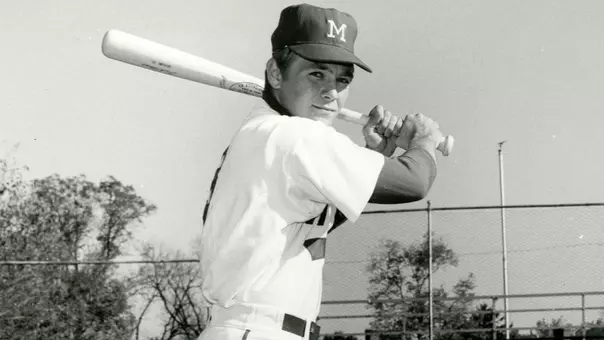
On a cold April day in 1971, Buddy Schultz ’73 did what no pitcher in NCAA baseball history had ever done or likely will ever do again.
Over the course of a nine-inning shutout of Wright State University, the left-hander with the searing fastball struck out 26 batters. Forty-five years later, the record remains a point of Miami pride, and the almost unfathomable idea of the accomplishment continues to raise eyebrows.
“I was on baseball cards, I played in five different countries, I’ve pitched with and against Hall of Famers, but, in this age where statistics have become so prominent, 26 strikeouts seems to be what I’m remembered for,” Schultz reflected. “It’s all good. What could possibly be bad when you were able to live your childhood dream?”
Today, the baseball that blew past that 26th batter—weathered and yellowed by age—rests prominently within Miami University’s new Jay Hayden Baseball Center. It is a piece of Miami Baseball history but only a singular glimpse into the drive and passion of a man who reached the game’s highest level and then dedicated his life to making those moments possible for others.
Schultz estimates he has helped raise more than $30 million in support of youth baseball leagues and facilities, including through Arizona Baseball Charities and his hometown East Cleveland Baseball Charities. His generosity and ability to motivate others behind an important cause were equally instrumental in building the Hayden Center as the home of Miami Baseball.
Schultz chaired the Legacy Project that named 40 lockers within the Miami Baseball Locker Room, and he and his wife, Toby, made a major gift naming the Toby K Schultz Heritage Hallway, a celebration of Miami Baseball’s tradition that includes Schultz’ life-size image and the historic baseball he treasures but wanted to share with the Miami family.
“Miami is special to me; it helped me grow up,” Schultz said. “I can’t pitch anymore, but this was how we could help Miami win.”
Drafted as a 17-year-old by the Philadelphia Phillies and offered $28,000—a significant amount at the time—to sign, Schultz instead chose Miami. Along with Head Coach Bud Middaugh and his teammates, he helped bring relevancy to a middle-of-the-pack program, beginning a run of 12 straight winning seasons.
Schultz, meanwhile, threw 240 strikeouts, posted a 1.77 career earned run average and was a two-time all-Mid-American Conference pick. He went on to sign with the Chicago Cubs for $6,000, which he used to finish his Miami degree. Schultz pitched five seasons for the Cubs and St. Louis Cardinals, and had the National League’s third-lowest ERA in 1977.
Inducted into the Miami Athletics Hall of Fame in 2010, Schultz, a resident of Scottsdale, Arizona, had maintained a connection to the university and the baseball program. It was Toby—the love of his life whom he met at a Tony LaRussa golf fundraiser—who motivated him to take that commitment to another level. In seeing Miami firsthand and witnessing Schultz’ devotion to the Jay Hayden Baseball Center and Legacy Project, she suggested they should do more. The result was the Toby K Schultz Heritage Hallway.
“I attended Miami because I could play baseball. I graduated from Miami because I like to win. I give back to Miami because others deserve a chance,” Schultz said. “Now I share Miami with the person I love most.”
The named hallway celebrates the Major League Baseball accomplishments of Miamians like Walter “Smokey” Alston ’35, Charlie Leibrandt ’78, Chris Sexton ’93 and Schultz himself. To Schultz, who will never forget the feeling of receiving a standing ovation from 40,000 St. Louis Cardinals fans, the gift naming the hallway is not about history but about the future.
“I give back because I’d like someone to be able to experience a little bit of what I did—to learn the things I was able to learn through baseball,” Schultz said. “Having our names in the Hayden Center and being part of that legacy is a bonus, but it’s not really about us. It’s about the kids and what we can do for them.”